


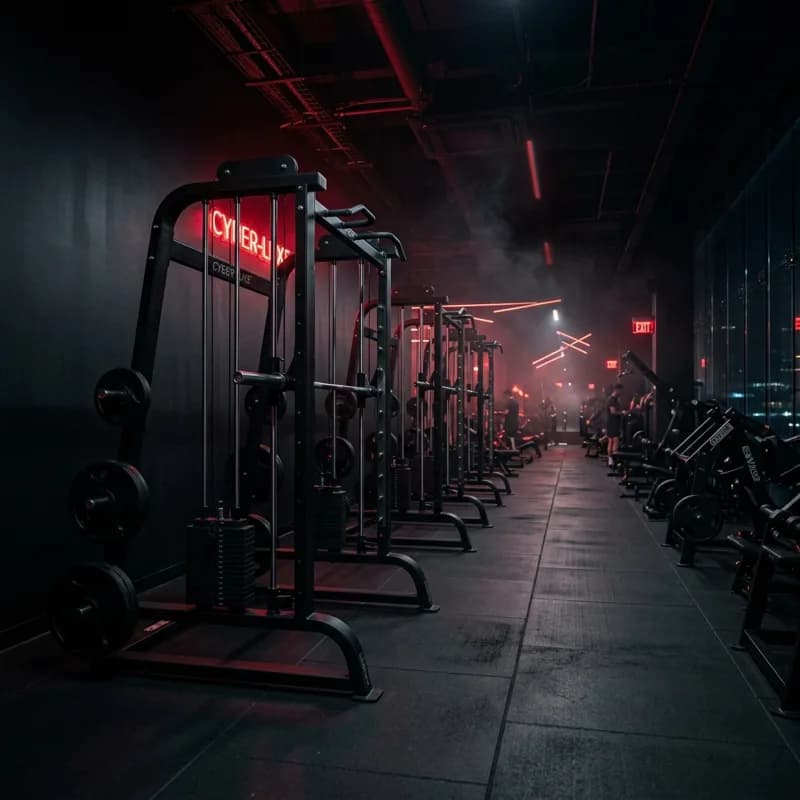
The debate between the traditional power rack and the commercial Smith machine has fueled gym lore for decades. Biomechanically, neither apparatus is superior in isolation; each serves a distinct neurological and kinetic purpose depending on whether the training objective is multi-planar stabilization or isolated mechanical tension.
1. Kinematic Differences: 3D Bar Freedom vs Linear Constraint
The primary mechanical difference lies in degrees of movement freedom. During a free barbell squat inside a power rack, the bar moves in three dimensions: vertically (Z-axis), anteroposteriorly (X-axis), and mediolaterally (Y-axis). Stabilizer muscle groups—including the gluteus medius, spinal erectors, and rotator cuff—fire constantly to maintain center of mass.
Conversely, a commercial Smith machine confines barbell displacement to a single vertical plane (or a 7-degree anatomical incline on advanced models) via hardened steel guide rods and linear ball bearings. Stabilizer recruitment decreases by 20% to 35%, redirecting systemic tension almost entirely into prime movers.
2. Hypertrophy Mechanics: Stability Equals Muscle Recruitment
In hypertrophy science, the principle of internal versus external stability dictates motor unit recruitment. When an athlete performs heavy Bulgarian split squats, overhead presses, or incline presses on a precision Smith machine:
- Targeted Fiber Recruitment: Because the balance variable is mechanically neutralized, the central nervous system can recruit high-threshold motor units without protective inhibition.
- True Muscle Failure: Athletes training alone can take sets safely to concentric failure and execute partial reps or dropsets by utilizing integrated twist-lock safety hooks.
- Joint Alignment: Lifters with joint limitations can adjust foot positioning forward during squats to eliminate lumbar shear stress, isolating the quadriceps.
3. Head-to-Head Biomechanical Comparison
| Biomechanical Variable | Free Barbell Power Rack | Linear Smith Machine | Training Advantage |
|---|---|---|---|
| Degrees of Freedom | 3 Dimensions (Full joint freedom) | 1 Dimension (Constrained track) | Rack for athletic transfer |
| Stabilizer Demand | Maximum (Core & joint stabilizers) | Minimal (Externally stabilized) | Rack for core coordination |
| Target Isolation | Distributed across kinetic chain | High focus on prime mover | Smith for hypertrophy |
| Solo Safety at Failure | Pin/strap catches (bar dump) | Rotational lockout hooks (instant) | Smith for solo lifters |
4. Programming Integration: How Elite Facilities Combine Both
High-performance coaches do not choose between apparatuses; they integrate both sequentially. A proven programming architecture pairs compound barbell movements in the power rack for intermuscular coordination with Smith machine variations for isolated metabolic fatigue:
- Movement 1 (Neural Peak): Low-bar barbell squat in the power rack (3-5 reps at 85% 1RM). Focus on 3D motor recruitment.
- Movement 2 (Hypertrophy Anchor): Smith machine incline press or split squat (8-12 reps with a controlled 3-second eccentric tempo).
- Movement 3 (Metabolic Stress): Smith machine calf raises or hip thrusts to absolute technical failure without balance fatigue.
5. Engineering Verdict
If your footprint restricts you to a single unit, assess your primary objective: athletic multi-planar power demands a heavy 11-gauge power rack, while pure muscular hypertrophy and solo safety favor a commercial dual-bearing Smith station. For elite facilities, pairing both represents the gold standard of modern biomechanical design.


Discussion & Comments (0)
Be the first to share your thoughts on this equipment guide.
Leave a Comment
Your comment will appear after moderation review.